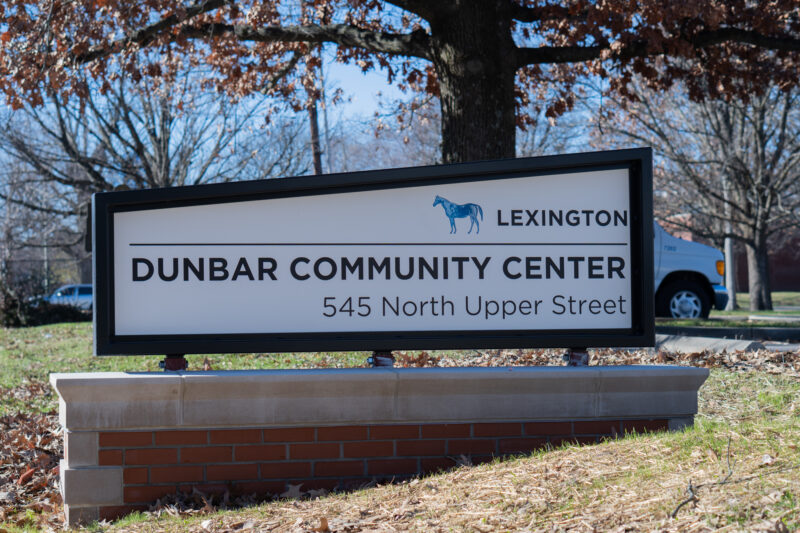
Erected on Feb. 15, 1923, the original Dunbar High School was named after the famous 19th-century poet Paul Laurence Dunbar. It was the first black high school in Kentucky to be admitted to the Southern Association of Colleges and Secondary Schools.
The building has a rich sports history. Legendary coach S.T. Roach built a basketball dynasty at the school, winning 512 games and capturing six regional titles and two Kentucky High School Athletic League State Championships. Numerous other championships were won across other sports over the school’s history. Major League Baseball notable Lou Johnson, whose iconic game-winning home run won the 1965 World Series for the Los Angeles Dodgers, was born in Lexington and attended Dunbar High School, where he played baseball and basketball.
In 1967 the school closed due to desegregation, with students divided among other high schools within Lexington. The building was acquired by Parks & Recreation in 1973. Portions of the old building, such as the original cornice above the entrance, were kept. The rest of the building was renovated and converted into a community center which opened in 1978. Other floors of the building were made into offices for Lexington Parks & Recreation, which are still used as offices for the division today.
Current Sustainable Practices
Below are the initiatives Dunbar Community Center has completed on the Green Check scorecard.
Sustainability Management and the Green Team
- Develop a written Comprehensive Sustainability Plan.
- Designate a Sustainability Coordinator or Green Team responsible for managing sustainability initiatives.
- Hold quarterly Green Team meetings.
- Provide time for quarterly sustainability updates in upper management meetings.
Awareness, Education and Outreach
- Share monthly sustainability tips in a newsletter or on social.
- Include a sustainability statement and training in new hire materials or at employee orientation.
- Promote sustainability accomplishments in external marketing materials.
- Provide volunteers for community environmental projects annually.
- Host an environmental event for the public or employees.
- Attend a sustainability workshop, tour or event.
Energy Efficiency
- Assess, track, and document energy consumption.
- Establish a power-down policy and checklist that includes items such as shutting off lights at night.
- Set water heater thermostats to a maximum of 120 degrees or install an inline water heater.
- Replace incandescent or CFL lights with LED lights 76-100% replacement.
- Achieve a year-over reduction in energy usage from the baseline of at least 5%.
- Establish a regular filter maintenance policy for your HVAC system.
- Have your HVAC system evaluated every 2 years by a certified service provider.
- Establish a policy for purchasing that requires Energy Star rated appliances and electronics.
- Install programmable thermostats and use them to adjust temperature during unoccupied hours.
- Install occupancy sensors in bathrooms, meeting rooms, and other infrequently used areas.
- Conduct an energy audit or assessment.
- Install or upgrade to energy efficient fans.
- Install energy efficient (i.e. Energy Star) rated windows in all conditioned spaces.
- Insulate roof to control energy loss.
- Install efficiency-rated HVAC of minimum standard SEER2 rating of 17.0.
- Take measures to insulate HVAC system and ductwork to minimize heat loss.
Waste Reduction and Recycling
- Implement a basic recycling program.
- Conduct a waste audit (within the past two years).
- Train and require janitorial service or staff responsible for cleaning to segregate waste and recyclable materials.
- Use reusable mugs and dishware instead of disposable plates, cups, and utensils in break room.
- Establish an electronic waste policy that diverts all e-waste away from landfill.
- Replace at least 50% of paper stock with post-consumer recycled paper.
Water Conservation
- Assess, track, and document water consumption.
- Conduct a water audit within the last three years.
- Establish a policy for purchase of high efficiency (i.e. WaterSense) rated fixtures and appliances.
- Install water efficient faucets in all of the restrooms.
- Install water efficient toilets in all of the restrooms.
Water Quality
- Establish preventative maintenance program for sanitary sewer lateral lines on your property.
- Post information in restrooms about proper disposal of flushable wipes and other items.
- Coordinate or participate in a litter clean-up.
Urban Forestry & Landscapes
- Establish a native species-only plant replacement policy for tree and shrub planting, where applicable.
Sustainable Purchasing
- Establish a policy for reducing the toxic chemicals/materials in your workplace.
Transportation Efficiency
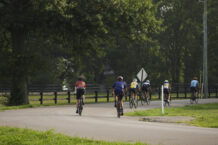
- Establish and implement a no-idling policy.
- Adopt a telecommuting option and make it available to employees.
- Install a bike rack with sufficient space for at least 10% of your employees.
- Install weather-protected bike storage (indoor or outdoor).
- Place bicycle storage closer than any other designated parking spot.
Innovation
- Hosts Nature in Your Neighborhood events
- Helps support community garden at William Wells Brown Community Center
- Composts food scraps
- Encourages carpooling for large events
- Offers bike locks to participants
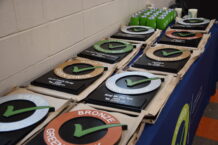
Certified as a Silver Green Check member since 2026